ChatGPT Search vs Google AI Overviews: Where B2B Brands Should Focus First

Most B2B teams are asking the wrong first question about AI search.
They ask which platform is bigger. They ask which one will win. They ask whether they should optimize for ChatGPT, Google, Perplexity, Gemini, or all of the above.
That framing sounds strategic. It usually delays execution.
The better question is this: where is your buyer most likely to form an opinion before visiting your site? Once you answer that, prioritization becomes much easier.
For most B2B brands in 2026, the real choice is not AI search versus traditional search. It is ChatGPT Search versus Google AI Overviews as the first answer layer you intentionally optimize for. Both matter. Very few teams can operationalize both at the same depth on day one.
This guide breaks down how the two systems differ, where each one creates leverage, and how content teams should decide where to focus first.
- Google AI Overviews usually matter more for broad discovery and high-volume informational queries
- ChatGPT Search matters more when buyers ask comparative, workflow, or recommendation-style questions
- B2B teams should prioritize the answer layer that matches current pipeline motion, not the one with the loudest headlines
- The winning workflow is often sequential: fix extraction for Google first, then expand citation readiness for ChatGPT
The core difference in one line
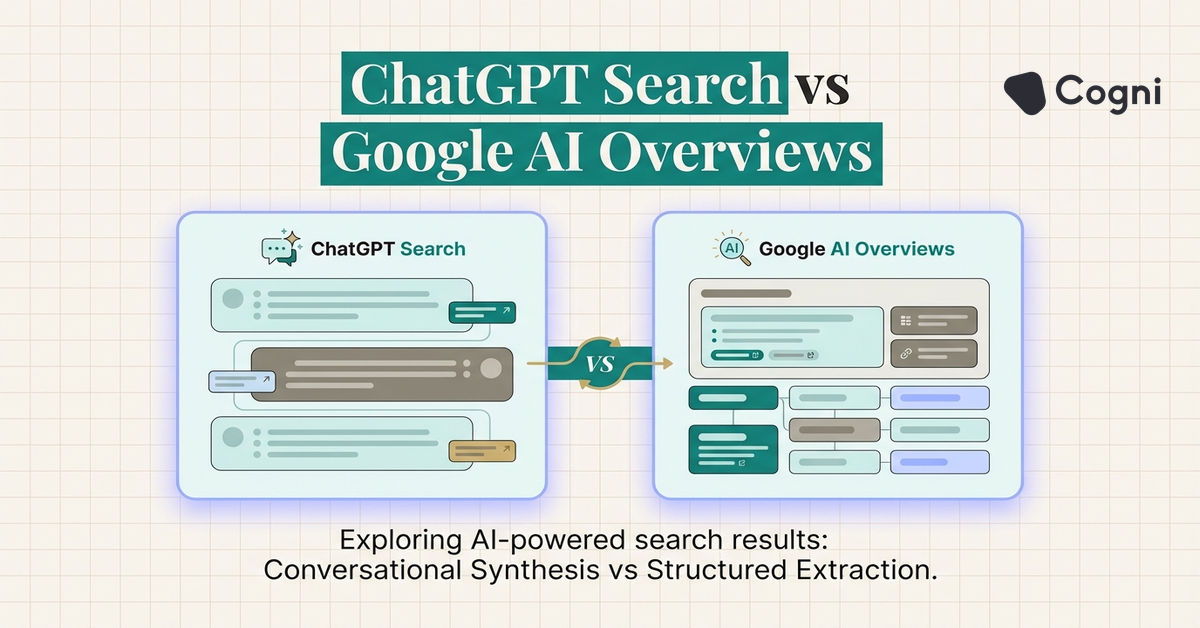
Google AI Overviews are still deeply connected to classic web retrieval. ChatGPT Search behaves more like an answer assistant that assembles recommendations from a smaller and often more selective set of sources.
That difference changes what it means to win.
In Google AI Overviews, visibility usually comes from being the cleanest answer to an established query pattern. In ChatGPT Search, visibility often comes from being a trusted source for a synthesized response that may combine product pages, editorial reviews, comparisons, and documentation.
If your team does not separate those retrieval patterns, your content plan will be too generic to perform in either.
Where Google AI Overviews usually win first
Google AI Overviews tend to show up earliest in the journey for broad educational and problem-framing queries such as:
- what is generative engine optimization
- how do AI overviews work
- how to optimize content for AI search
- answer engine optimization vs SEO
These are category-shaping prompts. They reward pages that are structurally clean, topically direct, and easy to summarize.
That means Google AI Overviews often favor pages with:
- a direct definition near the top
- clear heading hierarchy
- concise answer blocks
- fresh examples and cited claims
- strong internal links to canonical topic pages
This is one reason B2B teams that already have solid SEO foundations often see faster early gains in Google AI Overviews. The operational leap is meaningful, but it is not total reinvention.
Where ChatGPT Search creates different leverage
ChatGPT Search becomes more influential when the buyer intent is less about raw definition and more about synthesis.
Examples include:
- best tools for tracking AI citations
- how should a SaaS brand measure AI visibility
- compare AI search optimization platforms
- what should a content team do before launching a GEO program
These are not just ranking prompts. They are judgment prompts.
The system is effectively deciding which sources deserve to inform a recommendation. That usually means your brand needs more than a good explainer. It needs clear point of view, product clarity, consistent concept ownership, and enough third-party reinforcement to be selected with confidence.
This is why teams that only think in terms of blog rankings often underperform in ChatGPT Search. The system is not just looking for indexed relevance. It is looking for usable confidence.
A practical decision framework
If you need to choose where to focus first, score both systems across four questions.
| Question | If yes, prioritize Google AI Overviews first | If yes, prioritize ChatGPT Search first |
|---|---|---|
| Do you already rank for important informational queries? | Yes, you can often turn rankings into answer visibility faster | No, rankings alone will not create recommendation trust |
| Are buyers asking for comparisons and workflows? | Less often | More often, which makes answer synthesis more important |
| Is your site structurally strong but your brand authority still emerging? | Yes, extraction may improve before recommendation share does | No, you may already be ready for recommendation prompts |
| Do you need faster wins from existing content? | Usually yes | Only if your commercial pages are already citation-ready |
In plain English, here is the recommendation I would give most teams.
If your content engine is still maturing, start with Google AI Overviews. If your site is structurally strong and your buyers ask nuanced evaluation questions, invest harder in ChatGPT Search.
What optimizing for Google AI Overviews actually looks like
If Google AI Overviews is your first focus, the work should be content-operational, not mystical.
Start with these changes:
1. Rewrite the first 150 words of key pages
The opening section should define the topic quickly and clearly. Do not spend three paragraphs warming up. If the answer is buried, your odds of inclusion drop.
2. Add extraction-friendly sections
Use concise H2s, short paragraphs, bullets, and explicit comparisons. Pages that are easy to segment are easier to summarize.
3. Refresh examples and supporting data
Stale numbers reduce trust. Named sources and recent examples improve retrieval confidence.
4. Consolidate topic overlap
If three pages partially answer the same question, none may become the canonical answer in the answer layer.
For deeper formatting guidance, our post on how to structure content for Google AI Overviews covers the page design principles in more detail.
What optimizing for ChatGPT Search actually looks like
ChatGPT Search usually demands a broader trust surface.
That includes:
1. Strong commercial clarity
Your pricing, product, use case, and comparison pages need to be explicit. If your site is vague, the model has little reason to retrieve you for recommendation-heavy prompts.
2. Topic ownership beyond your own domain
Third-party references matter. Editorial mentions, quoted commentary, partner ecosystems, and clean thought leadership all increase the odds that your brand feels safe to include.
3. Better recommendation content
Create pages that directly help with evaluation:
- alternatives pages
- workflow guides
- tool comparisons
- implementation checklists
- role-specific use cases
4. Consistent entity signals
Make sure your company description, author bios, and category positioning are consistent across the site. Ambiguity is expensive in synthesized search.
The sequencing most teams should use
I rarely recommend treating this as an either-or forever decision.
A better sequence is:
- improve answer extraction on core category pages
- measure presence in Google AI Overviews
- identify high-intent prompts that look more like advisory questions
- build citation-ready commercial and comparison content for ChatGPT Search
- review prompt-level performance monthly
That sequence helps you avoid the classic mistake of jumping into recommendation queries before the foundations are strong.
For most B2B teams, Google AI Overviews are the easier first system to influence, but ChatGPT Search can become the higher-leverage system once your brand is credible enough to be recommended, not just retrieved.
Common mistake: choosing based on hype instead of buyer motion
A lot of teams chase the platform that dominates the timeline that week.
That is a bad operating model.
Prioritize the system where your buyers are already asking meaningful questions. If early discovery starts in Google, build there first. If prospects are increasingly using ChatGPT to shortlist tools and shape evaluation, adjust accordingly.
The point is not to predict the winner. The point is to win where intent is already shifting.
Frequently Asked Questions
Is ChatGPT Search more important than Google AI Overviews for B2B?
Not automatically. It depends on where your buyers ask category questions versus comparison questions. Google AI Overviews usually matter earlier for broad discovery. ChatGPT Search often matters more for evaluation and recommendation prompts.
Should teams optimize for both at the same time?
Yes, eventually. But most teams should sequence the work instead of splitting focus too early. Start where you can create measurable gains fastest.
What type of content helps with both systems?
Clear definitions, structured explainers, strong internal linking, fresh evidence, and direct comparisons tend to help across both. The difference is that ChatGPT Search usually needs more trust and recommendation context.
How do I know where to start?
Run prompt tests across your top commercial and educational queries. If you are already close to visibility on Google but absent in recommendation prompts, start with Google AI Overviews and expand into ChatGPT Search next.
Final thought
The smartest B2B teams are not asking whether AI search matters anymore.
They are building a content system that treats each answer layer according to how it actually works.
Google AI Overviews reward answer clarity. ChatGPT Search rewards trusted synthesis. If you know which one your buyers rely on first, you know where to focus next.