GEO vs SEO: What's the Difference and Why Both Matter in 2026

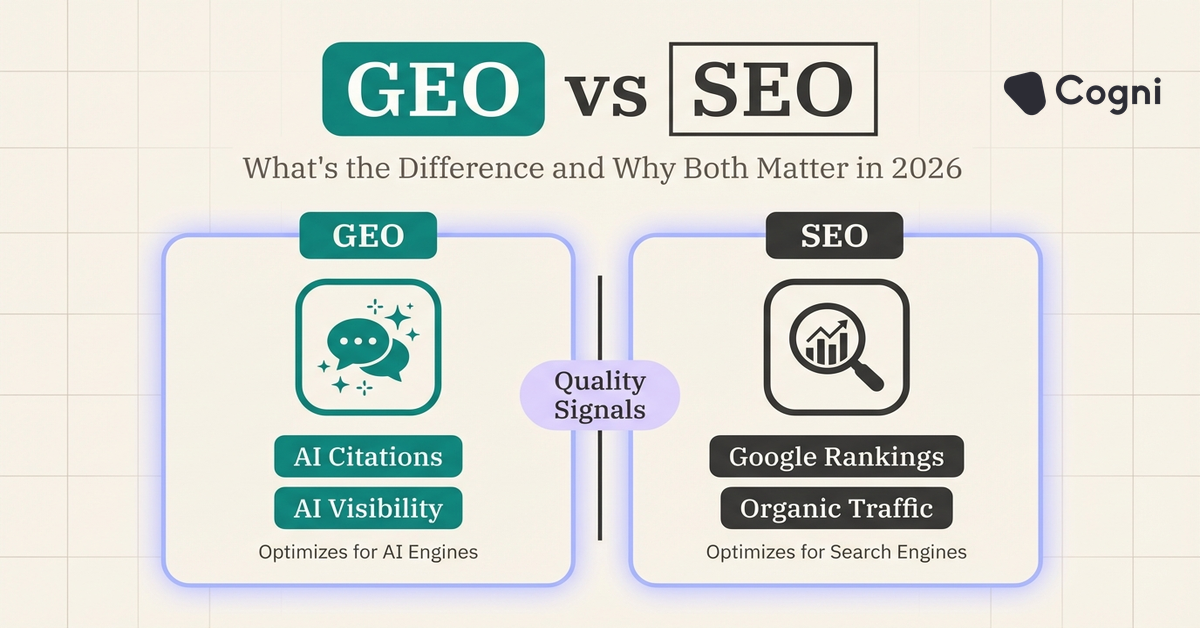
- SEO optimizes for Google's ranking algorithm. GEO optimizes for AI-generated answers and citations.
- The two disciplines have different success metrics: rankings vs. citation share and AI visibility score.
- Research published at KDD 2024 shows GEO tactics can boost AI visibility by up to 40% without harming traditional SEO performance.
- Brands that treat GEO and SEO as separate strategies will underperform those that integrate them from the start.
- The content formats that win in GEO (definitions, FAQs, named statistics) also strengthen your SEO signal.
The search landscape fractured in 2023 and has not snapped back together. When a user types a question into ChatGPT, Perplexity, or Google's AI Overview, they get a synthesized answer, not a ranked list of blue links. The source of that answer is rarely the site ranking number one on Google. It is the site whose content was most extractable, most authoritative, and most structurally suited to AI summarization.
That gap is where GEO lives.
This post explains the precise difference between generative engine optimization and traditional SEO, where the two strategies overlap, and how to build a content approach that performs in both environments. If you are running content for any brand in 2026, understanding this distinction is not optional.
What Is Generative Engine Optimization (GEO)?
Generative engine optimization (GEO) is the practice of structuring and improving content so that AI-powered search systems, including ChatGPT, Perplexity AI, Google AI Overviews, and Claude, cite, extract, and feature that content in their generated responses.
The term was formally defined in the paper "GEO: Generative Engine Optimization" by Aggarwal et al., published at KDD 2024 (arXiv:2311.09735). The researchers introduced GEO as a new optimization paradigm that addresses a fundamental shift in information retrieval: users increasingly receive synthesized answers from large language models rather than ranked lists of links. GEO gives content creators a framework for remaining visible in this new environment.
Traditional SEO was designed for a world where humans click links. GEO is designed for a world where AI systems synthesize content on behalf of humans and cite sources within those synthesized responses.
What Is Traditional SEO?
Search engine optimization (SEO) is the practice of improving a website's content, technical structure, and authority signals so that it ranks higher in traditional search engine results pages, primarily Google and Bing. The discipline has existed in recognizable form since the late 1990s and has been refined around Google's ranking algorithm, which evaluates factors including page authority, content relevance, user engagement signals, technical health, and experience, expertise, authoritativeness, and trustworthiness (E-E-A-T).
When done well, SEO drives organic traffic by placing your content in front of users who are actively searching for a topic. The primary success metric is rank position and the organic traffic that follows from it.
How GEO and SEO Differ: A Direct Comparison
The two disciplines share a goal (visibility) but differ in almost every other dimension. Understanding these differences prevents you from applying outdated SEO tactics to an AI search problem, and vice versa.
| Dimension | Traditional SEO | GEO |
|---|---|---|
| Target system | Google/Bing ranking algorithm | ChatGPT, Perplexity, Claude, AI Overviews |
| Success metric | Keyword rank, organic traffic | Citation share, AI visibility score |
| Content format priority | Long-form keyword-dense posts | Structured definitions, FAQs, data tables |
| Link signals | Backlinks drive authority | Named citations and source diversity drive inclusion |
| Primary user interaction | Click-through to website | AI synthesizes answer; user may not visit site |
| Technical requirements | Page speed, Core Web Vitals, indexing | Crawlability by AI bots, clean content structure |
| Optimization timeline | Weeks to months for ranking movement | Can affect AI citation within days of a crawl |
| Primary competition | Other pages ranking for the same keyword | Other sources synthesized in the same AI answer |
How Traditional SEO Works
SEO optimization centers on satisfying Google's ranking signals. A simplified version of how a high-ranking page gets there:
- Googlebot crawls the page and indexes its content
- Google evaluates the page's relevance to a query using semantic analysis of the content
- Google assesses the page's authority using backlink signals (PageRank)
- Google evaluates E-E-A-T signals: is the author credible? Is the content trustworthy?
- Google measures user behavior signals: dwell time, bounce rate, click-through rate from search
- The page receives a rank position for its target keyword
A well-executed SEO strategy produces a page that ranks in position 1-3 for its primary keyword, receives consistent organic traffic, and converts visitors into leads or customers. The human user is always in the loop: they see the result, decide to click, and arrive at your site.
How GEO Works Differently
GEO optimization centers on satisfying the extraction and citation logic of generative AI systems. The process is different at every step:
- An AI crawler (GPTBot, PerplexityBot, ClaudeBot) crawls the page
- The AI model evaluates whether the content answers a user query in a way that is directly extractable
- The model evaluates whether the source is authoritative enough to cite in a response
- The model synthesizes an answer, potentially incorporating a snippet or data point from the page
- The model includes a citation (a link or reference to the source) in its response
- The user sees the synthesized answer and may or may not click through to the source site
The user interaction is fundamentally different. In traditional SEO, the user chose to click your result. In GEO, an AI model chose to cite your content. The human is consuming a synthesis, not visiting your site directly.
According to Aggarwal et al. in "GEO: Generative Engine Optimization" (KDD 2024), applying GEO tactics including statistics citation, quotation from authoritative sources, and fluency improvements can boost a website's visibility in AI-generated responses by up to 40%. The study tested 10 distinct optimization strategies across a benchmark of 10,000 queries and found that adding verifiable statistics was the single highest-impact intervention.
Where GEO and SEO Overlap
Despite their differences, GEO and SEO converge on several foundational principles. This convergence is good news for content teams: investing in these shared signals improves performance in both environments simultaneously.
Quality and Depth of Content
Both Google and generative AI models reward comprehensive, accurate, well-researched content. Thin pages that cover a topic superficially rank poorly in traditional search and get passed over by AI citation systems in favor of more authoritative sources. The investment in quality has compound returns.
Technical Accessibility
Both SEO and GEO require that your content be technically accessible. For SEO, this means Googlebot can crawl and index the page. For GEO, this means AI crawlers (GPTBot, PerplexityBot, OAI-SearchBot) can access the page. A page that blocks AI bots via robots.txt is invisible to generative engines regardless of its content quality. Both disciplines share this dependency on clean technical infrastructure.
Authority and Trust Signals
Google's E-E-A-T (Experience, Expertise, Authoritativeness, Trustworthiness) framework and AI citation logic both favor authoritative sources. A domain with strong backlink authority, clear author credentials, and factual accuracy signals is more likely to rank in traditional search AND more likely to be cited by AI systems. Building domain authority has cross-channel payoffs.
Structured Content
Headers, bullet lists, tables, definitions, and FAQ sections all improve readability for both human users (a UX signal for SEO) and AI extraction systems (a GEO signal). Well-structured content is easier for AI to parse and synthesize, and it keeps human visitors engaged longer, both of which help.
Where GEO and SEO Diverge Most Sharply
Success Metrics
SEO teams measure rank positions, organic traffic, click-through rates, and conversions. GEO teams measure citation share (how often your brand is cited in AI responses to relevant queries), AI visibility score, and source diversity (how many different AI platforms cite your content).
At Cogni, we track both metric sets simultaneously. We have observed cases where a page ranks in position 4-6 on Google for a keyword but appears in 60% of Perplexity responses for the same query. The inverse also happens: position-1 Google pages that are never cited by AI systems because their content structure is not extraction-friendly.
Content Format Requirements
Traditional SEO rewards long-form content that comprehensively covers a topic with keywords naturally embedded throughout. GEO rewards content that includes a clear definition early, uses named statistics with source attribution, presents data in tables, and structures FAQs with self-contained answers that can stand alone as AI responses.
The practical difference: an SEO-optimized 2,000-word blog post that buries its key insight in paragraph seven will underperform in GEO. A GEO-optimized post surfaces its most citable insight within the first three paragraphs, states it as a clean, extractable sentence, and attributes it to a named source.
The Role of Links
In SEO, backlinks are the primary authority signal. More high-quality backlinks from authoritative domains correlate strongly with higher rankings. In GEO, backlinks still matter as a proxy for domain authority, but they are not the primary citation trigger. AI systems make citation decisions based on content relevance, structural clarity, and extractability alongside domain authority.
Building a Strategy That Covers Both
The practical synthesis: treat GEO requirements as additions to your existing SEO workflow, not replacements for it.
Step 1: Start with keyword research for SEO, then validate for GEO. Use your standard keyword research process to identify what your audience searches for. Then check whether those same questions are being asked in AI search tools. The overlap is usually high, but AI search surfaces different follow-up questions that can inform your FAQ sections.
Step 2: Write for human comprehension first, AI extraction second. Your H1 should contain the primary keyword (SEO requirement). Your first 300 words should include a clear definition paragraph (GEO requirement). These two requirements do not conflict.
Step 3: Build a FAQ section for every post. FAQ sections are the single highest-leverage GEO element. AI models extract Q&A pairs constantly. They also signal to Google that your content addresses a broad range of user questions, which improves semantic relevance. FAQs are a dual-channel win.
Step 4: Name your statistics. Replace "studies show that..." with "According to [Study Name] by [Organization], [Year], [specific finding]." Named statistics are more credible to human readers, pass Google's E-E-A-T signals, and are far more likely to be cited verbatim by AI systems.
Step 5: Maintain one robots.txt strategy for both channels. Do not block AI search crawlers. GPTBot (OpenAI's training crawler) and OAI-SearchBot (OpenAI's search crawler) are distinct. Blocking GPTBot keeps your content out of training data. Blocking OAI-SearchBot removes you from ChatGPT search results. Review your robots.txt to ensure search-oriented AI bots have access to your content. See our complete GEO guide for the full breakdown.
Step 6: Measure both channels. Track traditional search performance (rank, traffic) and AI visibility (citation rate, citation share) separately. The two metrics are related but not perfectly correlated. A page can perform well in one channel and poorly in the other. Measurement reveals the gaps that optimization can close.
Frequently Asked Questions
What is the main difference between GEO and SEO?
SEO optimizes content to rank in traditional search engine results pages, primarily Google, by satisfying ranking signals like backlinks, relevance, and user engagement. GEO optimizes content to be cited and extracted by AI-generated answer systems like ChatGPT, Perplexity, and Google AI Overviews, by prioritizing structured definitions, named statistics, and FAQ sections that AI models can directly synthesize into their responses.
Does GEO replace SEO?
No. GEO and SEO are complementary disciplines that target different search channels. Google still processes over 8.5 billion searches per day and remains the dominant discovery channel for most content. GEO becomes necessary because a growing share of informational queries are resolved by AI tools that synthesize answers without sending the user to a website. Brands that ignore GEO will be invisible to a fast-growing portion of their audience.
Can optimizing for GEO hurt my SEO performance?
Not when done correctly. The GEO tactics with the strongest evidence behind them, including structured definitions, FAQ sections, named statistics, and clear content organization, also align with Google's E-E-A-T guidelines and improve user experience. The KDD 2024 GEO research paper found that applying GEO tactics improved AI visibility by up to 40% without degrading traditional search performance.
How do I measure GEO performance?
GEO performance is measured by tracking citation share: how frequently your brand or content appears when specific queries are submitted to AI tools. The manual approach involves running a set of target queries across ChatGPT, Perplexity, and Google AI Overviews and recording when your content is cited. Tools like Cogni automate this tracking across multiple queries and platforms. See meetcogni.com for more on AI visibility measurement.
Which AI search engines should I optimize for first?
Prioritize Perplexity AI and ChatGPT (with search enabled), as they are currently the most frequently cited by content marketers as discovery tools for information-seeking queries. Google AI Overviews reach a larger absolute audience because they appear within existing Google searches. A well-structured GEO strategy improves visibility across all three simultaneously, since the underlying optimization signals, structured content, named data, and clear definitions, are consistent across platforms.
Is GEO just SEO with a different name?
No, though they share foundations. GEO introduces distinct requirements: the definition paragraph format, self-contained FAQ answers, named statistics with explicit source attribution, and a focus on content extractability rather than just content depth. A page that ranks number one in Google will not necessarily appear in AI-generated responses. The two channels have enough divergence that treating them as identical leads to underperformance in both.
Conclusion
SEO built the playbook for winning organic visibility in a world of ranked links. GEO is building the playbook for winning organic visibility in a world of AI-synthesized answers. The rules differ. The skills overlap. The brands that figure out how to run both simultaneously will have a structural content advantage that compound over time.
The good news: most of what makes content excellent for GEO, clarity, credibility, structure, and named data, also makes it excellent for traditional SEO. The investment is not either/or. It is about sequencing correctly and measuring both channels.
If your content strategy is not tracking citation share alongside rank position in 2026, you are measuring half the picture. Cogni tracks both.