How to Structure Content for Google AI Overviews Without Writing Robotic SEO Copy

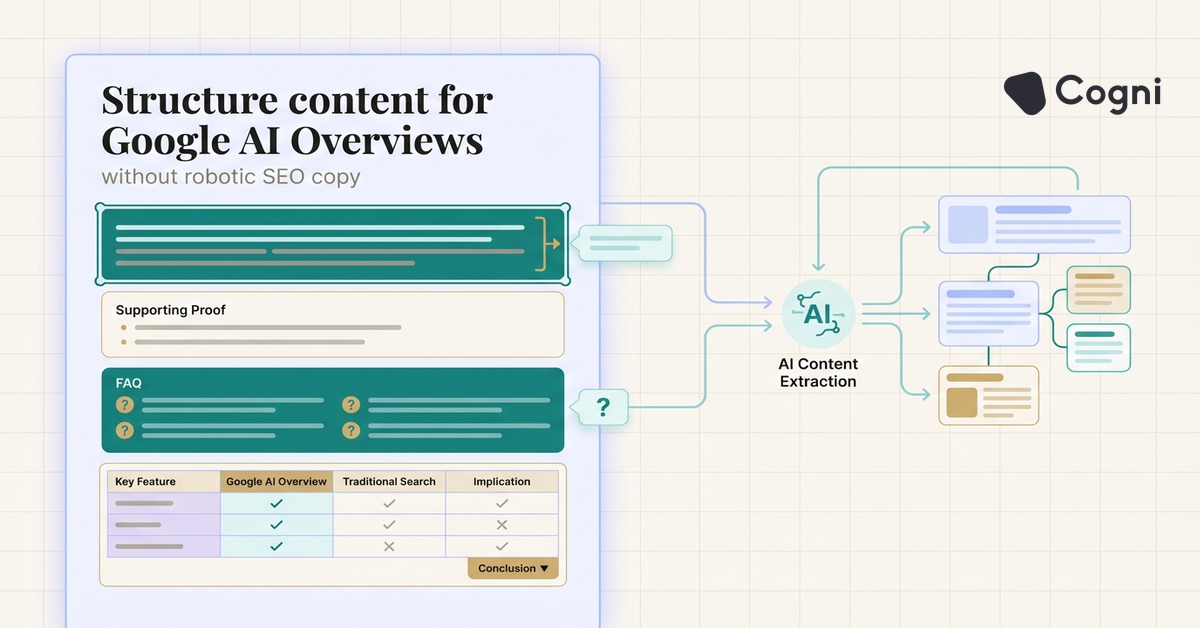
- Google AI Overviews reward extractable structure, not stiff keyword stuffing
- Pages that answer one question cleanly, then expand with evidence, are easier for AI systems to synthesize
- FAQ blocks, comparison tables, and explicit definitions increase answer eligibility
- At Cogni, we see stronger AI visibility when content is written for retrieval first and ranking second
The worst way to optimize for AI Overviews is to sound like you are optimizing for AI Overviews.
A lot of brands are responding to Google’s answer-first search experience by producing flat, repetitive copy. Every heading becomes a keyword variation. Every paragraph starts sounding like a featured snippet audition. The result is content that is theoretically structured for AI extraction and practically unreadable for humans.
That tradeoff is unnecessary. Google AI Overviews favor content that is easy to extract, verify, and combine into a direct answer. They do not require robotic prose. They require disciplined structure.
According to BrightEdge Research in 2025, 57% of search queries now trigger AI Overviews. According to Google, AI Overviews are designed to handle broader, more complex, multi-part queries that previously required several searches. That means pages no longer compete only for a blue link. They compete to become one of the passages Google trusts enough to synthesize.
The practical implication is simple: if your page buries the answer, overcomplicates the structure, or makes the evidence hard to isolate, it is less likely to be used.
What “structured for AI Overviews” actually means
Structured content is not just content with headings. It is content that can be broken into clean answer units without losing meaning.
Content structured for Google AI Overviews presents a direct answer early, expands it with evidence, and organizes each supporting section so it can stand on its own. That means your introduction clarifies the problem, your first section defines the concept, and each later section answers a distinct follow-up question.
This is why old-school “ultimate guide” sprawl underperforms in many answer-first contexts. Those posts often have depth, but the useful pieces are buried in narrative buildup. AI systems prefer pages where the best paragraph is obvious.
At Cogni, I have found that the highest-performing overview-friendly posts follow a three-layer structure:
- direct answer
- supporting proof
- decision framework
If a page does not have all three, it tends to be informative but not extractable.
The core building blocks of overview-friendly pages
1. A definition or answer block near the top
Your first 150 to 300 words should answer the exact query the page targets. Not vaguely. Not with a long scene-setting intro. Directly.
According to Google’s own AI search guidance, systems work best when content clearly explains who, what, why, and how. The opening section is where that clarity starts.
2. Heading structure that mirrors search intent
Every H2 should represent a real sub-question. Good H2s often sound like search prompts:
- What is Google AI Overview optimization?
- Why do some pages get used in AI answers?
- How should you format content for extractability?
- What mistakes reduce overview eligibility?
That pattern makes the page easier for both readers and machines to navigate.
3. Evidence close to the claim
If a paragraph makes a strong claim, the data should appear in the same section, not five scrolls later. According to Princeton, Georgia Tech, and IIT Delhi’s KDD 2024 GEO paper, content with citations, statistics, and fluent structure saw measurable visibility lifts in generative search environments. Claims without evidence are harder for AI systems to trust and harder for human editors to defend.
4. Explicit comparisons and frameworks
AI systems like bounded structures. Tables, checklists, and side-by-side comparisons make synthesis easier.
| Content pattern | Why it works in AI Overviews | What to avoid |
|---|---|---|
| Short direct definition | Gives Google a clean extraction candidate early | Long intros that delay the answer |
| Question-shaped H2s | Maps naturally to multi-step query expansion | Generic H2s like “Benefits” or “Overview” |
| Evidence in the same section as the point | Improves passage-level trust and usability | Claims that rely on citations elsewhere in the post |
| FAQ block | Creates standalone answers for long-tail prompts | Thin FAQs written only for schema stuffing |
How to write for extractability without sounding synthetic
The trick is to separate structure from tone.
Structure should be rigid. Tone should stay human.
That means you can write a strong, opinionated sentence like “Most brands are still formatting blog posts for rankings, not retrieval,” as long as the surrounding section makes the claim easy to parse. You do not need to flatten the voice. You need to sharpen the information architecture.
A reliable workflow looks like this:
- start with the exact question the page should answer
- write a two-sentence answer before the introduction
- expand into sections that each resolve one follow-up question
- add one table, one FAQ, and one evidence callout
- remove any paragraph that sounds smart but adds no extractable value
The pages most likely to appear in AI Overviews are often not the longest pages. They are the pages with the clearest answer path from query to paragraph to proof.
Common mistakes that reduce AI Overview visibility
The first mistake is treating the whole article like one undifferentiated wall of insight. AI systems work at passage level. If a section cannot stand on its own, it is weaker as an extraction candidate.
The second mistake is keyword choreography. You can tell when a page has been contorted around query variants instead of written around decisions readers actually need to make.
The third mistake is separating expertise from evidence. Practitioner voice matters. Data matters. The strongest content uses both in the same section.
The fourth mistake is forgetting the next question. Google AI Overviews are often triggered by complex queries, which means your page should anticipate what the reader asks after the first answer. That is why FAQ sections and comparison tables still matter so much.
If you need a cleaner content foundation before tuning for AI Overviews, start with Generative Engine Optimization tactics and then layer in answer-first formatting. If your team is trying to map the broader discipline, read our guide to what is answer engine optimization.
A simple framework for editors and content teams
Before publishing a page, ask five questions:
- Is the direct answer visible in the first 300 words?
- Does each H2 answer a real sub-question?
- Are key claims paired with named evidence?
- Is there at least one table or framework that simplifies synthesis?
- Would each FAQ answer still make sense if copied into an AI response?
If the answer to two or more is no, the post is probably not ready.
How do I optimize content for Google AI Overviews?
Start with a direct answer near the top of the page, then support it with structured sections, evidence, and FAQ content. The goal is to make each key passage easy for Google to extract and trust.
Do AI Overviews prefer short content?
Not necessarily. They prefer content with clear structure and high information density. A longer post can perform well if the best answer is easy to find and the support is well organized.
Should every blog post target AI Overviews?
No. Some posts are better suited for opinion, brand storytelling, or demand capture. Pages targeting informational queries and comparisons are usually the best candidates for overview optimization.
Is schema markup enough to get into AI Overviews?
No. Schema helps machines understand structure, but it does not replace strong content. Google still needs a useful page with credible, extractable information.
What is the biggest mistake brands make with AI Overview content?
They make the writing sound mechanical in the name of structure. Good overview content is tightly organized, but it still reads like it was written by someone with a point of view.
Conclusion
The future of search content is not robotic. It is more disciplined.
The brands that win AI Overviews will not be the ones stuffing pages with variants. They will be the ones making complex ideas easier to extract, verify, and trust.
If your content is hard to lift into an answer, it is hard to win in answer-first search. Build pages that do both, with help from Cogni.