The Perplexity Brand Visibility Playbook for 2026

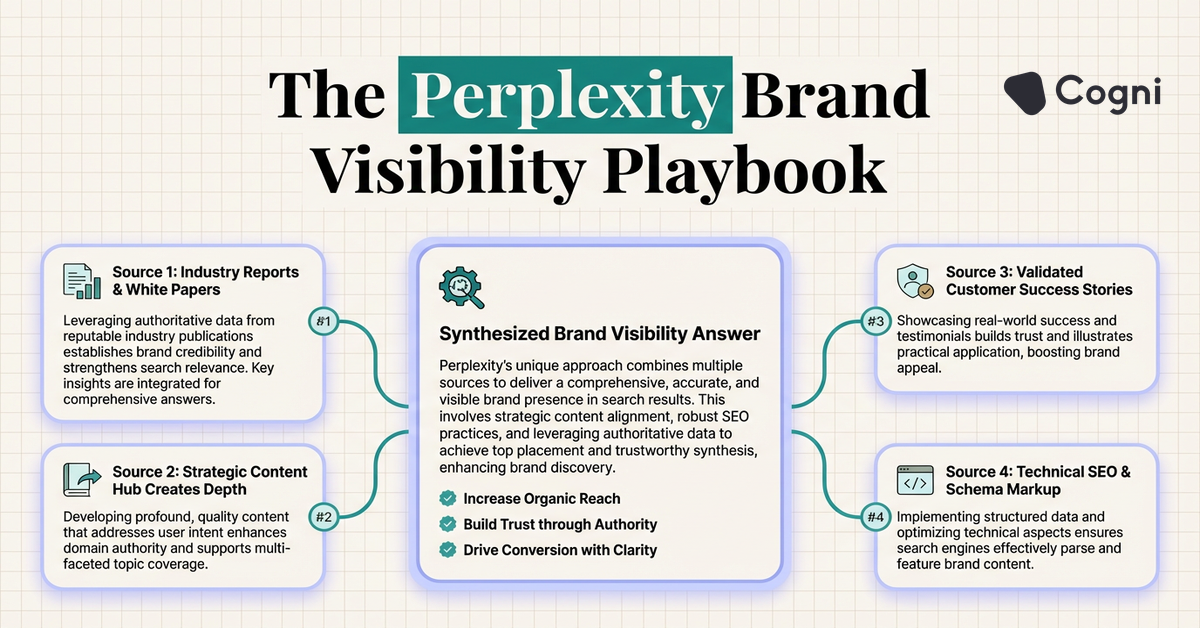
Perplexity is one of the clearest signals that search behavior is shifting from pages to answers.
It does not just list results. It assembles them. It cites them. It conditions users to expect direct synthesis instead of ten blue links.
For brands, that creates an uncomfortable truth.
If your site is not built to become a source inside an answer, visibility in Perplexity will stay inconsistent no matter how much content you publish.
The good news is that Perplexity is also unusually useful for diagnosis. Because it exposes sources directly, you can often see which types of pages, claims, and brands it prefers.
This playbook explains how to improve brand visibility in Perplexity, what patterns matter most, and how to build a content system that earns more citations over time.
- Perplexity rewards sources that are clear, specific, and easy to cite inside synthesized answers
- Brands gain visibility faster when they own concepts, not just product claims
- Comparison pages, benchmark pages, and structured explainers often outperform vague thought leadership
- A repeatable prompt-testing workflow is essential for measuring progress in Perplexity
Why Perplexity matters
Perplexity is not the biggest traffic source for every brand today. That is not the point.
It matters because it makes answer-layer dynamics visible.
When a user asks Perplexity a category question, the system often reveals:
- which sources it trusts
- which pages are easiest to synthesize
- which brands own the concept
- which evidence gets repeated
That makes it one of the best live environments for learning what citation readiness looks like in practice.
What Perplexity tends to favor
Perplexity does not cite pages at random. The pages that appear repeatedly usually share a few traits.
1. Clear definitions and scoped answers
Pages that answer a narrow question directly are easier to include than sprawling opinion pieces.
2. Named evidence
If a claim has a source, a date, and a recognizable organization attached, it becomes safer to cite.
3. Category ownership
Brands that repeatedly explain a concept well often show up even when the prompt is not branded.
4. Good comparison logic
Evaluation prompts often pull from pages that compare options, frameworks, or tradeoffs explicitly.
5. External validation
Perplexity often blends owned and third-party sources. If your brand only exists on its own domain, your citation surface is thinner.
The three layers of visibility in Perplexity
Most teams think they either appear or do not appear. In reality, there are at least three levels.
Level 1: Mentioned
Your brand is included as one example among several. This is progress, but it is still weak ownership.
Level 2: Cited
Your page is used as an explicit source. This is stronger because the system is trusting your page directly.
Level 3: Relied on
Your framing shapes the answer itself. Even when multiple sources appear, your definitions, taxonomy, or examples anchor the synthesis.
The goal is not just to be present. The goal is to become structurally useful enough that the system leans on you.
The content types that tend to work best
If you want faster gains in Perplexity, start with these formats.
Structured explainers
These help on educational prompts and category questions. They are especially strong when they define a term, explain why it matters, and include implementation detail.
Comparison pages
These help on evaluation prompts. They are powerful when they present differences clearly instead of pretending every option is equal.
Research-backed benchmark posts
These help when the answer requires evidence. Specific statistics and methodology details increase citation utility.
Workflow guides
These help when the user asks what to do, not just what something means.
If your current library is mostly trend commentary, your visibility ceiling in Perplexity will be lower than you think.
A workflow for improving Perplexity visibility
Here is the process I recommend.
Step 1: Build a prompt library
Create a list of 30 to 50 prompts across:
- category education
- comparisons
- implementation questions
- strategic buyer questions
- adjacent problem statements
Do not rely on one or two vanity queries. You need breadth.
Step 2: Score current presence
For each prompt, log whether your brand is:
- absent
- mentioned
- cited
- primary source
This gives you a baseline that can be tracked monthly.
Step 3: Map prompts to target pages
Every high-value prompt should have a candidate page on your site. If it does not, that is a content gap.
Step 4: Upgrade target pages for citation readiness
Improve:
- opening definitions
- heading clarity
- evidence density
- examples
- FAQ coverage
- internal links to the canonical page
Step 5: Expand third-party reinforcement
A brand that only cites itself is easier to ignore. Push thought leadership, partner content, expert quotes, and external mentions that reinforce your category authority.
What to fix on-page first
If I had to prioritize a small batch of changes, I would start here.
| Priority | Change | Reason |
|---|---|---|
| High | Direct answer in first section | Improves extraction and summary quality |
| High | Named data points and sources | Increases trust and citation safety |
| Medium | Comparison sections and tradeoffs | Helps advisory and recommendation prompts |
| Medium | FAQ blocks with exact-match phrasing | Captures common follow-up questions |
| Medium | Updated examples and timestamps | Signals recency on fast-moving topics |
The authority problem most brands miss
A brand can have accurate content and still be under-cited in Perplexity because it has not earned concept association.
This happens when the site focuses only on product messaging. The brand explains what it sells but never becomes one of the sources people use to understand the category itself.
If you want more presence in Perplexity, publish content that helps the market think, not just buy.
That includes:
- canonical guides
- frameworks and taxonomies
- benchmark data
- comparison logic
- practical implementation checklists
This is also why a guide like AI search visibility audit can support broader answer-layer visibility. It gives the market a repeatable way to think about the problem.
Perplexity visibility is less about chasing a single trick and more about becoming one of the easiest credible sources to synthesize across your category.
Frequently Asked Questions
How do I improve visibility in Perplexity?
Start by testing important prompts, mapping them to target pages, and improving those pages for direct answers, evidence, and clear structure. Then build external signals that reinforce category authority.
Does Perplexity favor big brands?
Big brands often have an advantage, but smaller brands can still win if their pages are more focused, better structured, and more useful for synthesis.
What pages are most likely to get cited in Perplexity?
Structured explainers, comparison pages, benchmark posts, and workflow guides tend to perform best because they are easy to retrieve and summarize.
How often should I test Perplexity prompts?
Monthly is a good baseline. If your team is actively publishing or rebuilding category pages, test more frequently during the rollout.
Final thought
Perplexity is a useful proving ground for the future of brand discovery.
If your content is easy to cite, your visibility compounds. If your content is vague, fragmented, or hard to trust, the system will route around you.
That is why the right playbook is not about gaming Perplexity. It is about building pages the answer layer genuinely wants to use.